
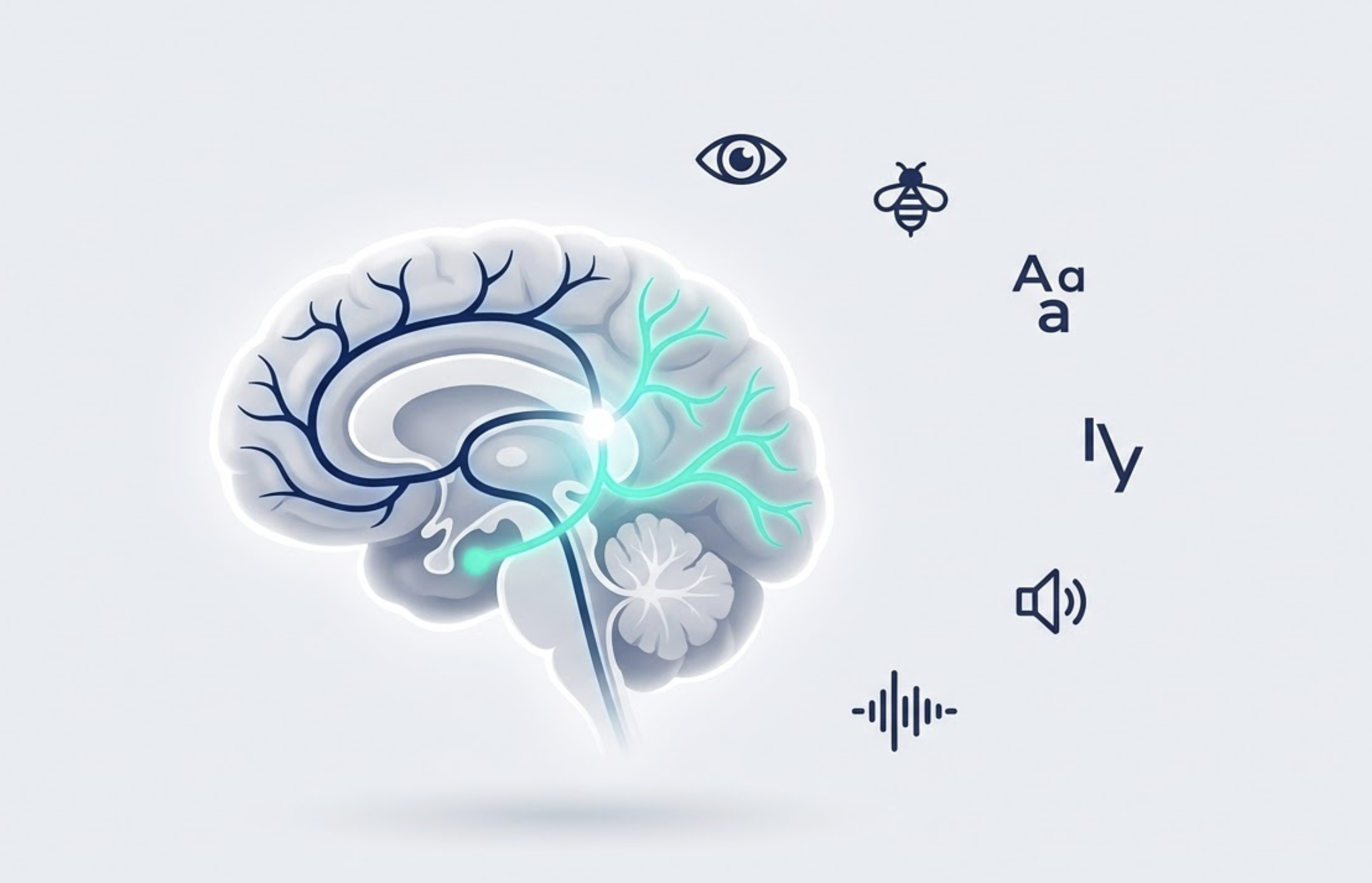
Why Rebus Puzzles Enhance Memory: The Neuroscience Behind the Aha Moment
Most of us learn things by reading them. We scan text, absorb meaning, and move on. It feels efficient. But from the brain's perspective, reading a word is among the least durable ways to encode it into memory. Text travels a single cognitive highway, the verbal processing channel, and leaves a comparatively shallow imprint. Forget something you read a week ago? There is a structural reason for that.
Rebus puzzles work differently. At their core, a rebus is a format that represents words or phrases using a combination of pictures, symbols, numbers, and individual letters, requiring the solver to translate across multiple cognitive registers simultaneously to arrive at meaning. A drawing of an eye, plus a picture of a can, plus the letter "T" resolves to "I can't." Sounds simple. Neurologically, it is anything but. And that complexity, counterintuitively, is exactly what makes rebus puzzles such a powerful engine for memory formation.
Dual Channels, Double the Retention
To understand why rebus puzzles encode so effectively, it helps to start with a foundational framework in cognitive science: dual coding theory, developed by psychologist Allan Paivio at the University of Western Ontario in the late 1960s. Paivio's core argument is that the human mind operates two functionally separate but interacting memory systems, a verbal system for processing language, and an imagery system for processing nonlinguistic visual information.
When you encounter a piece of information through only one system, say, reading a definition, memory traces are laid down in a single location. When the same information arrives through both systems simultaneously , when a concept has both a verbal label and a visual representation , traces are encoded in two separate functional locations. A piece of information stored in two locations has a measurably better chance of being retrieved later. This is not a metaphor. It is a testable, repeatedly validated prediction.
A rebus puzzle is, structurally, a forced activation of both channels. The solver cannot engage with a rebus using only verbal processing, because the stimulus is partly visual. And they cannot decode it using only visual pattern recognition, because the solution is a word or phrase, a linguistic object. The puzzle's format compels both systems to engage, cooperate, and synthesize. The result is a memory trace that is doubly anchored.
fMRI research published in Memory and Cognition lends direct neurological support to this account. When participants encoded words by drawing them, a process analogous to rebus construction in that it forces visual, verbal, and motoric representations to converge, they showed significantly higher retrieval rates compared to those who simply wrote the words. Brain scans confirmed that this memory advantage correlated with activation in the angular gyrus and bilateral frontal regions (associated with semantic integration), the visual cortex, and premotor areas. See the fMRI multimodal reactivation study. The drawn words had, in effect, been stored in richer, more redundant neural structure, a multimodal architecture that created multiple retrieval pathways to the same piece of information.
The Phonological Puzzle Within the Puzzle
Rebus puzzles add a layer that standard dual-coding exercises do not: they require the solver to translate the sounds of object names into linguistic meaning. When you look at a picture of a bee and the letter "N," you are not responding to the bee's visual appearance or ecological role, you are processing the phonological identity of the word "bee" and using that sound to construct the syllable "been." This is a cognitively unusual operation.
Research published in Frontiers in Human Neuroscience offers remarkable evidence of how deeply this phonological-visual link runs. In a series of experiments, participants shown image pairs that formed rebus combinations, without being told that any wordplay was involved, produced significantly more rebus-related associations than control groups. They were solving the rebuses without conscious knowledge that there were rebuses to solve. The researchers concluded that "the world is also apprehended as a phonological trace, independently of its semantic meaning," suggesting that the mind automatically and unconsciously processes the sound-names of objects it perceives, in parallel with their visual and semantic content. See the Frontiers in Human Neuroscience rebus study.
This finding has significant implications for memory. When a rebus puzzle is solved consciously, the solver is deliberately engaging a phonological processing pathway that the brain activates even beneath awareness. Conscious engagement deepens and reinforces a process that is already running in the background, creating an unusually well-integrated memory trace that spans visual perception, phonological processing, and semantic comprehension, three separate cognitive operations converging on a single moment of resolution.
The Aha Moment Is Not Just Satisfaction, It Is a Memory Event
Anyone who has solved a rebus puzzle knows the experience: a period of apparent impossibility, a stretch of mental searching, and then a sudden collapse of confusion into clarity. This is the insight experience, the so-called aha moment. It feels rewarding. But beyond feeling rewarding, it is neurologically distinct from ordinary comprehension, and that distinction matters enormously for memory.
A study published in Nature Communications used fMRI to examine what happens in the brain during moments of strong visual insight. Participants solved Mooney images, high-contrast black-and-white photographs of real-world objects that appear as meaningless abstract shapes until a moment of sudden perceptual recognition. The cognitive operation they require is closely analogous to rebus solving: in both cases, the solver must reorganize an ambiguous perceptual input into a coherent interpretation through a sudden shift in how the stimulus is mentally represented.
The study found that the anterior hippocampus and amygdala became increasingly active during high-insight moments, forming an integrated network with visual processing areas. See the Nature Communications aha moment memory study. The strength of this network integration directly predicted whether participants could recall the solution five days later. Participants were substantially more likely to remember solutions that had been accompanied by strong insight experiences. This is the insight memory advantage: solutions reached via genuine moments of cognitive surprise are encoded in long-term memory with significantly greater durability than solutions arrived at through methodical, incremental reasoning.
Rebus puzzles are structurally positioned to produce exactly this kind of insight event. Every successful rebus solution involves, in miniature, that neural reorganization, the sudden coalescence of visual, phonological, and semantic processing, and each one stamps the resolved meaning into durable long-term storage. If you want to build this mental habit, Puzzlit delivers a daily rebus challenge designed to trigger exactly these insight-driven memory events.
Evidence Across the Lifespan: From Vocabulary Acquisition to Cognitive Protection
The memory-enhancing properties of rebus-style puzzles are not confined to a single developmental window. The evidence extends from early learning all the way to late-life cognitive protection.
In educational contexts, the dual-channel engagement of visual-verbal puzzles has been specifically linked to vocabulary retention. When a learner must decode a word's meaning through both a visual representation and its phonological label, the word is encoded in richer neural structure and is substantially less likely to be forgotten than a word encountered through written definition alone. This is the practical application of Paivio's dual coding principle: the more cognitive registers a piece of information activates during encoding, the more retrieval pathways exist to reach it later.
At the other end of the age spectrum, a large-scale study of 19,078 adults between the ages of 50 and 93 found that frequency of word puzzle engagement was directly and significantly associated with cognitive function across all 14 cognitive measures assessed, including focused attention, information processing speed, executive function, working memory, and episodic memory. See the word puzzle and cognitive function study in the International Journal of Geriatric Psychiatry. The pattern was dose-dependent: participants who never engaged with word puzzles consistently scored at the bottom of the distribution, while those who engaged daily showed the strongest performance. Speed-based processing measures provided the sharpest differentiation, with a statistically significant difference of approximately 8 age-years between the most and least engaged groups.
Research examining puzzle engagement and cognitive aging more broadly found that people with greater lifetime puzzle experience demonstrated measurably better visuospatial cognition even after controlling for age and other protective lifestyle factors. The correlation between puzzle-solving skill and global visuospatial cognitive ability reached r = 0.80, an unusually strong association for a leisure activity. See the Frontiers in Aging Neuroscience jigsaw puzzling and cognitive aging study. Rebus puzzles share a substantial portion of the same cognitive demands, including visuospatial pattern recognition, perceptual integration, and sustained strategic attention, that the authors identified as the likely protective mechanisms. Sustained puzzle engagement over a lifetime builds and maintains the neural infrastructure underlying spatial memory and flexible reasoning in ways that shorter interventions cannot replicate.
What Makes Rebus Puzzles Distinctively Valuable
Many activities improve cognitive performance through engagement and challenge. What sets rebus puzzles apart is the specific combination of mechanisms they activate simultaneously.
First, they are inherently multimodal. A rebus cannot be solved through a single cognitive register. Visual processing, phonological processing, and linguistic synthesis must all cooperate. This forced integration produces memory traces that are structurally richer than those formed by any single-channel activity.
Second, they reliably produce insight events. The perceptual shift required to read a picture not as an image but as a sound is, by cognitive definition, a restructuring of representation, and restructuring events activate the hippocampal-amygdalar memory consolidation network identified in the Nature Communications research.
Third, they operate at the intersection of conscious and unconscious processing. Research demonstrates that phonological object-naming is activated automatically, even without intent or awareness. When a solver consciously engages a rebus, they are reinforcing and deepening a cognitive operation the brain already performs beneath awareness, creating a cross-level memory trace that is unusually stable.
Fourth, they are scalable in difficulty and format. A rebus can be calibrated from a single-syllable picture pun to a multi-image compound phrase requiring several sequential decoding steps, making the format appropriate for a wide range of cognitive profiles, ages, and learning contexts.
Together these properties make rebus puzzles one of the few cognitive activities that simultaneously engage dual-channel encoding, produce genuine insight events, reinforce unconscious phonological processing, and remain practically accessible without specialized equipment or training. Explore a curated daily rebus experience at Puzzlit, designed to keep this full suite of cognitive mechanisms engaged.
Memory Is Built Through Complexity
The brain is not a passive recorder. It encodes most durably what surprises it, what requires effort to resolve, and what arrives through multiple channels simultaneously. Rebus puzzles, by their structural nature, satisfy all three conditions. They demand multimodal engagement. They generate insight experiences. They activate phonological processing pathways that run deeper than conscious reading. And the neuroscience is increasingly clear: these are not incidental features but precisely the conditions under which the hippocampus, amygdala, and visual cortex form the kinds of integrated, redundant memory traces that survive across days, weeks, and decades.
The humble rebus is not a trick or a novelty. It is a memory technology, one that encodes information through surprise, synthesis, and the peculiar human ability to hear a picture speak.
References and Further Reading
- PMC / Frontiers in Human Neuroscience: "People solve rebuses unwittingly, Both forward and backward: Empirical evidence for the mental effectiveness of the signifier"
- PubMed / International Journal of Geriatric Psychiatry: "An online investigation of the relationship between the frequency of word puzzle use and cognitive function in a large sample of older adults"
- PubMed / Memory and Cognition: "Brain regions supporting retrieval of words drawn at encoding: fMRI evidence for multimodal reactivation"
- PMC / Frontiers in Aging Neuroscience: "Jigsaw Puzzling Taps Multiple Cognitive Abilities and Is a Potential Protective Factor for Cognitive Aging"
- PsyPost / Nature Communications: "Neuroscientists discover how 'aha' moments rewire the brain to enhance memory"
Experience the Aha Moment Daily
Ready to build sharper memories through daily rebus challenges? Try Emote It, Puzzlit's emoji decoding puzzle that triggers the same insight-driven memory events described above. Or explore Chain It for word-linking challenges. See all 13+ puzzle types.
Also read: How crosswords and Sudoku reduce anxiety